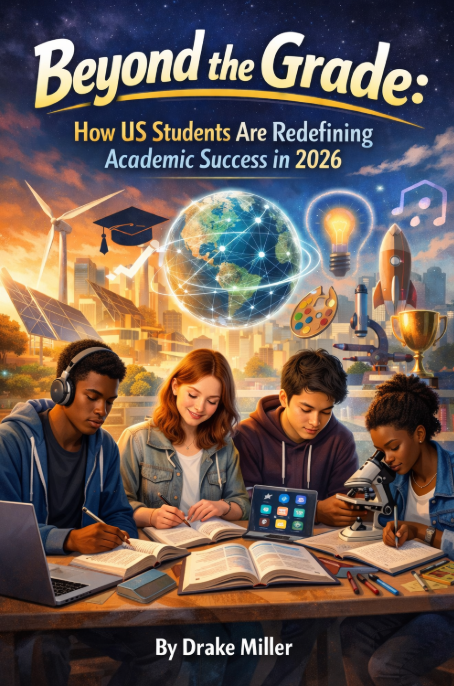
By Drake Miller
The life of a modern student in 2026 is a high-stakes environment defined by “The Great Acceleration.” From high schoolers navigating the hyper-competitive rigors of Advanced Placement (AP) courses to university students tackling interdisciplinary thesis projects, the academic landscape has shifted fundamentally. It is no longer enough to simply “know” the material; students must now manage it like a professional project.
As an academic strategist, I have watched a significant evolution in the student psyche. Rather than being crushed by these demands, modern students are adopting what psychologist Carol Dweck calls a growth mindset. They are viewing a difficult assignment not as a dead end, but as a springboard for personal and professional development. This evolution isn’t just about “trying harder”; it’s about “learning smarter” in a hyper-competitive global economy.
The 2026 Academic Landscape: Managing Information Overload
To understand how students are growing, we must first acknowledge the hurdles. In the United States, the competition for elite college admissions and specialized career roles has necessitated a curriculum that moves faster than ever. The “standard” academic load has expanded significantly over the last decade, often requiring students to be proficient in data analysis and digital literacy before they even step onto a university campus.
Furthermore, the digital age has brought a double-edged sword: unlimited information but limited focus. Students are expected to master complex software and AI-driven learning management systems (LMS) while simultaneously mastering traditional subjects like calculus and organic chemistry. In 2026, the “average” student is essentially a project manager of their own education, balancing specialized research with a high-velocity digital presence.
From Obstacle to Opportunity: Strategies for Growth
Today’s high-achieving students are no longer passive learners. They are “educational architects” who use specific strategies to turn bottlenecks into breakthroughs. Here is how they are turning specific challenges into growth opportunities:
1. Embracing Iterative Failure in STEM
The most significant shift I’ve observed in the last few years is the evaporation of the stigma surrounding academic help. High-achieving students recognize that they cannot be experts in everything simultaneously. They treat their education like a startup, and themselves as the CEO.
Just as a CEO hires consultants to solve complex problems, modern students leverage professional resources like Myassignmenthelp.com as a strategic advantage. When a student utilizes specialized thesis help , they aren’t looking for a “shortcut.” They are seeking a roadmap for complex research methodologies and structural frameworks that a 45-minute lecture cannot fully cover.
2. Strategic Resource Management: The “CEO Approach” to Learning
In a world of information overload, the ability to distill a complex argument into a single, punchy sentence is a superpower. Many students struggle with the transition from “writing a report” to “defending a position.”
To bridge this gap, top-tier students often study a variety of thesis statement examples to understand how to anchor their research. By analyzing these models, they fill knowledge gaps and master rubrics more efficiently, maximizing their “Return on Effort” (ROE) in a crowded schedule.
3. Mastering Executive Function through Overwhelming Schedules
The “challenge” of a 15-credit semester, a professional internship, and leadership in extracurriculars is a pressure cooker. However, students are using this pressure to master the art of productivity and executive function.
Using sophisticated tools like Notion, Trello, and Google Calendar to audit their time, they are building the organizational muscles required to manage large-scale corporate projects. The “opportunity” here is the development of a professional-grade workflow before they ever enter the full-time job market.
4. Turning Peer Competition into Collaborative Leadership
The hyper-competitive nature of modern grading scales can be isolating. Yet, many students are “flipping the script” by forming digital study groups and collaborative Discord servers. They are turning the challenge of a “curved” grade into an opportunity to practice collaborative leadership.
By teaching a peer a difficult concept, the student reinforces their own understanding—a phenomenon known as the “Protégé Effect.” This collaborative spirit mirrors the “squad” or “agile” models used in modern tech companies, preparing students for a workplace that values team success over individual ego.
See also: How Blockchain Works
The Role of EdTech in Facilitating Autonomy
We cannot discuss modern academic growth without mentioning the role of EdTech. Digital platforms have democratized information. If a student finds a classroom lecture confusing, they now have the autonomy to find a different perspective online instantly.
This autonomy fosters independent learning. Modern students are building their own paths to understanding by combining classroom instruction with YouTube tutorials, AI-driven study aids, and professional academic consulting. This ability to “learn how to learn” is perhaps the greatest opportunity born out of academic difficulty. In a world where the half-life of professional skills is shrinking, the ability to self-tutor is the ultimate competitive advantage.
Frequently Asked Questions
Q.1 What is a growth mindset in education?
Based on the research of Carol Dweck and advocated by experts like Drake Miller, a growth mindset is the belief that intelligence and academic abilities can be developed through dedication, strategic effort, and the right resources.
Q.2 How can students overcome academic burnout?
Overcoming burnout requires “strategic outsourcing.” By using tools like Notion for organization and MyAssignmentHelp for complex project guidance, students reduce cognitive load and focus on high-priority mastery.
Q.3 Is seeking assignment help considered a valid study strategy in 2026?
Yes. High-achieving students use academic support as a “consultancy model.” By reviewing expert explanations, students deconstruct complex rubrics and master difficult concepts faster than they would through unguided struggle.
Q.4 Why do US universities emphasize “academic resilience”?
Resilience is a top-tier soft skill. Universities focus on it because students who can navigate rigorous grading and complex research projects demonstrate the adaptability needed for the modern workforce.
Conclusion: The Resilient Leader
The habits formed while struggling with a complex university dissertation or a difficult high school essay are the same habits that drive career success: adaptability, critical thinking, and resilience.
The modern student is proving that a challenge is simply an opportunity in disguise. By utilizing every tool in their arsenal—from peer Discord servers to professional services like MyAssignmentHelp—they are doing more than just passing exams. They are building the grit and resourcefulness required to navigate an uncertain world. As we look toward the future of education, the goal isn’t to remove the obstacles from the student’s path, but to give the student the tools to climb over them.
About the Author: Drake Miller
Drake Miller is a leading Academic Strategist and Education Consultant specializing in student productivity and higher education trends in the USA. With over a decade of experience in curriculum development, Drake focuses on helping students navigate the transition from high school to elite university environments through the lens of the “Growth Mindset.” His work advocates for the integration of technology and strategic academic support in modern learning.